





Cement industry striving for carbon neutrality
ABSTRACT. The means of reducing greenhouse gas emissions in cement industry include the replacement of part of the clinker in cement with mineral additives, the use of alternative raw materials and fuels, the recarbonization of materials, the development of innovative technologies, etc. The article provides information about a number of projects aimed at reducing CO2 emissions during the life cycle of cement, and about the costs associated with reducing its carbon footprint.
Keywords: CO2 emissions; supplementary cementitious materials; alternative raw materials and fuels; carbon capture, utilization and storage.
1. Introduction
0.7 gm of CO2 will be released during the production of 1 kilogramme of OPC. Most of the emissions are caused by the production of clinker. Between 50 and 60 percent of these emissions are caused by the calcination of the limestone, and the majority of the rest are caused by burning fossil fuels to reach the necessary kiln temperatures. The production of cement is responsible for about 7—8 % of all carbon dioxide emissions in the world. By 2050, the demand for cement will increase in tandem with population growth. It will be crucial to reduce these emissions if the world is to meet its climate goals.
2. Innovation is being used to address the abatement challenges in the cement industry
The cement industry faces especially difficult challenges when it comes to reducing emissions. Because manufacturers’ profit margins are too narrow to cover them, new industrial processes that produce less pollution typically have higher production costs. Industry is also resistant to change because it has heavily invested in the current system of doing things.
Clinker substitution and carbon capture, to a lesser extent, are established mitigation techniques. Both must overcome specific obstacles. Alternative fuels, such as used tyres and household waste, plastics etc. are frequently used. The process releases carbon from these wastes while displacing the use of fossil fuels.
Process innovation, carbon capture, and use. Carbon capture entails separating CO2 from other gases in exhaust in order to store CO2 underground. The higher cost of this method including storage infrastructure the cost of capture is going down as technology is used more affordably at smaller scales. The challenge is how to make these technologies affordable in commercia scale.
Additionally, new calciner configurations can enable electrification or the use of alternative fuels while maintaining the separation of process and fuel emissions. Leilac is currently using technology to capture about 100,000 TPA of CO2 in Hanover, Germany, and construction will start in 2023.
Some of the difficulties associated with capture and storage can be solved by using carbon in fuels, chemicals, building materials, and other products. Concrete is cured using CO2 in CarbonCure and Carbicrete, for instance. The concrete mix and the injected CO2 react, forming calcium carbonate that increases the concrete’s compressive strength and enhances its durability.
Clinker substitution and additional cementitious materials. Clinker substitution entails replacing clinker with increasing volumes of SCM. Depending on the rate of substitution, these cements, which are now produced on a large scale by many cement companies, can dramatically reduce emissions. The method may be restricted by prescriptive standards (which call for minimum clinker ratios) and may be restricted by the availability of additional cementitious materials in the future (common SCMs include fly ash from the coal-fired plants or blast furnace slag from the steel industry).
Fund raising efforts by innovators to scale the use of substitute supplementary cementitious materials are increasing. To speed up the commercialization of Terra’s OPUS cementitious materials derived from a variety of regional feedstocks and waste products, Terra CO2 raised $46M in June 2022. When post-consumer coloured glass fines are activated using Carbon Upcycling’s carbon utilisation technique, CO2 emissions are sucked up and high-performance SCMs are created. This technology is now in pilot testing.
Fund raising efforts by innovators to scale the use of substitute supplementary cementitious materials are increasing. To speed up the commercialization of Terra’s OPUS cementitious materials derived from a variety of regional feedstocks and waste products, Terra CO2 raised $46M in June 2022. When post-consumer coloured glass fines are activated using Carbon Upcycling’s carbon utilisation technique, CO2 emissions are sucked up and high-performance SCMs are created. This technology is now in pilot testing.
Alternate raw materials, integrated processes, and alternative cements. Using alternate raw materials or techniques that do not require calcining limestone for clinker manufacture can significantly reduce emissions. The materials used as SCM are frequently also employed as binding materials (when activated).
The use of «bio-cement,» which is made when organisms break down limestone and then reconstitute it to create an end product like bio-concrete, can also result in significant reductions.
Across the value chain innovation. The cement industry’s emissions can be greatly reduced through innovation, but it will need finance to scale and lower costs. An emphasis on performance-based standards can also assist alternative cements get access to the market. Additional innovation across the value chain is also to be anticipated: large amounts of CO2 can be sequestered by the mineralization of aggregates, production facilities can benefit from software that optimises production processes and blends, and concrete 3D printing can help with installation optimization.
One of the businesses seeking to exploit carbon dioxide emissions to produce fuels or chemicals is Synhelion. The startup creates syngas from CO2 and water using focused sun radiation. In December 2022, the company raised $24 million from CEMEX and other sources, and is presently building an industrial facility to make sustainable fuels with solar heat (and captured carbon). In order to create solar clinker, the startup additionally connected its solar receiver to a CEMEX clinker production process one of the holding’s enterprises in order to exclude the use of natural fuels in this process (without use of fossil fuels).
3. Despite the Genuine Effort made, much remains to be done
The major players have vowed to achieve carbon neutrality by 2050 through the Global Cement and Concrete Association (see the figure ). By 2050, cement manufacturers would actually need to reduce emissions from one tonne to 375 kilos of CO2 per tonne of cement produced. If this goal is to have any chance of success, it will be costly and ambitious. Around 80 % of the emissions are produced during the cement-making process, specifically during the chemical transformation of clinker, the product of firing clay and limestone rocks at a temperature of about 1450 °C.
Clinker makes up 95 % of Portland cement, a conventional and extremely unfriendly cement. With the use of greener substitutes like waste products, cement companies are concentrating on lowering the percentage of clinker in the composition of cement (e.g., Fly ash). Additionally, recycling materials strengthens circular economy initiatives and generates significant cost savings. The effectiveness of manufacturing procedures must be increased by cement manufacturers. This can be accomplished by making investments in new locations and switching to cleaner kiln fuels.
A specific illustration of this is the use of biomass waste in place of the fossil fuels previously used to power kilns. Industry leaders like Holcim have been able to reduce their emissions by 30 % since the 1990s and are aiming for an additional 20 % reduction between now and 2030 as a result of these measures. The carbon intensity directly associated with cement production, however, increased by 1.5 % annually between 2015 and 2021, despite the fact that the IEA estimates a 3 % annual reduction is required until 2030 in order to achieve a «net zero emissions» scenario for 2050.
With 6 % of all man-made emissions, cement is the second largest industry emitting after steel. Societal needs and urbanization are expected to increase cement demand by 45 % by 2050. As part of the Net-Zero by 2050 pathway proposed by the IEA, however, the increase should be limited to today’s levels.
The cement industry can already reduce emissions today without introducing disruptive technologies by leveraging efficiency and circularity levers like lowering the clinker-to-cement ratio and utilising waste from other industries as alternative fuels. The only known method for bringing sectoral emissions close to zero is by using CCUS technology. Its use today could result in a 50—85 % rise in production costs. By 2030, the technology is anticipated to be at the commercial level (?).
In addition to investments in carbon capture on industrial assets, at least $ 185 billion is required to create the infrastructure for low-emission power and hydrogen production, as well as the transport and storage of 1,370 MTPA of CO2 (the second-largest need in the IEA Net Zero by 2050 Scenario).
Low-carbon cement is anticipated to enter the market with a green premium above 50 % due to the high cost of carbon capture, which would result in a 1—3 % rise in housing costs. The cement consumers’ demand signals for low-emission cement are essential for motivating investments. To do this, cement buyers’ confidence in their capacity to transfer the premium on to final consumers must be strengthened.
For first movers in the low-emission cement sector, greater international collaboration and stronger regulatory measures, such as carbon pricing, carbon border adjustment mechanisms, circularity, or product specification standards, can help develop a competitive and financially sustainable market. By 2050, the sector will need to invest $500 billion in carbon capture technologies, or $16 billion annually on top of current investments. A sufficient taxonomy and substantial governmental finance assistance will make it easier to get green bonds, which will help the business case.
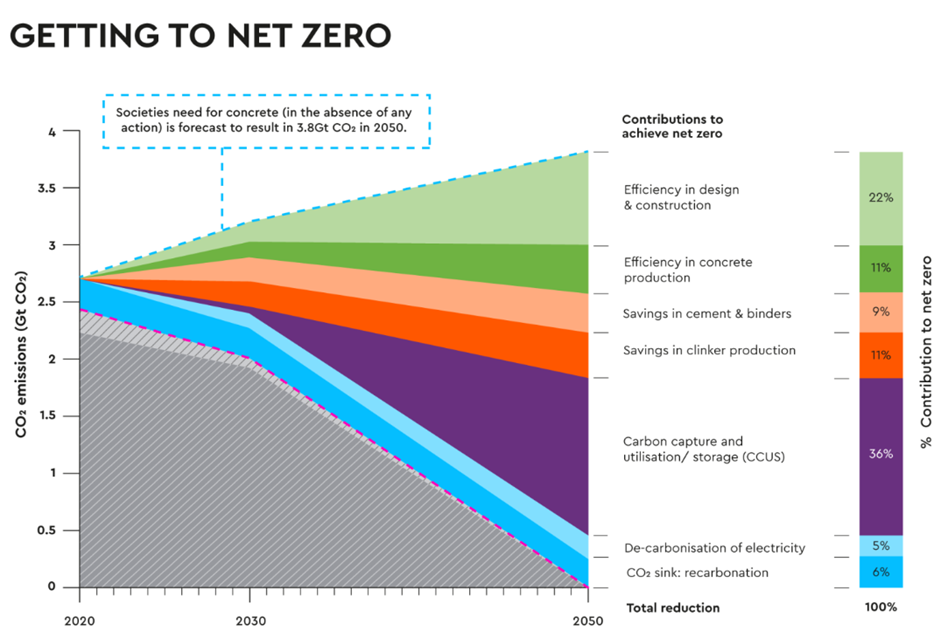
Getting to Net Zero — GCCA Roadmap
4. Avenues for Net Zero Potential:
We reiterate the following actions on immediate basis:
- Introduce efficiency measures to promote recycling of concrete and maximise emission reduction in current operations.
- Increase the number of carbon capture initiatives to quicken the technology’s learning curve, lower costs, and advance commercial readiness.
- Create the infrastructure needed for CO2 transit and storage to enable the production of low-emission cement.
- Increase the number of low-emission cement demand signals to encourage investors and manufacturers to invest money in low-emission assets.
- Create policies to support the aforementioned four targets and bolster the commercial viability of producing low-carbon cement.
- Electrification with storage. Renewable energy has helped dramatically reduce the carbon intensity of electricity across the globe.
- Green gas and biomass, hybrid heating, Hydrogen and CCUS.
There is a lot of work that needs to be done. International standards must be used to define «low-emission» industries.
Technologies for carbon-free manufacturing must demonstrate their viability on a large scale. Consumer acceptance and awareness must increase in order to generate demand for low emission products. Building infrastructure is necessary to develop and integrate low-carbon processes.
Markets with low carbon emissions need to become profitable. It is necessary to «de-risk» investments to speed up capital inflows. Change can be encouraged and facilitated with a solid policy foundation.
Governments and businesses should step up their efforts to quicken the decarbonization process, increase energy efficiency, and lessen reliance on fossil fuels.
These and other objectives cannot be achieved without a paradigm shift in multistakeholder collaboration across vast industrial ecosystems. If equity and justice are not prioritized during industry transitions, neither of them can be achieved. It is necessary for people’s opportunities and means of subsistence.
Industrial decarbonization might be one of the most challenging energy transition challenges to overcome. The industry has well-established paths to net-zero, and transparency is rising. We might look back on this decade as one of the major turning points for net-zero sectors if the global aspiration and spirit of cooperation inspire effective action.
| Author: Dr. S.B. Hegde |
| Section: Ecology and safety |
| Keywords: CO2 emissions, supplementary cementitious materials; alternative raw materials and fuels, carbon capture, utilization and storage |