





Energy optimizing furnace slag as a potential supplementary cementitious material for cement
ABSTRACT. Steel smelting technology in a furnace with optimized energy consumption (Energy Optimizing Furnace, EOF) was developed as an alternative to the classic open-hearth process. Despite being mineralogically rich, the EOF slag is almost untouched and has not been explored for a significant scope of recyclability. Herein the mineralogy and microstructure of EOF slag have been studied with different sophisticated analytical techniques including optical polarizing microscopy, and X‑ray diffraction. Different compositions of blended cement have been made by using the processed and ground EOF slag, and different performance parameters of the developed cement have been evaluated. The reactivity of the EOF slag in cement hydration has been analyzed by correlating the quantitative XRD data, Heat of Hydration of the developed cement, and derived physical parameters. It has been found that ground EOF slag (GEOFS) is a potential supplementary material for blended cement with the 2.5 to 7.5 % replacement of ground granulated blast furnace slag. This can both expand the possibilities of industrial waste utilization and help reduce the clinker factor in cement for the reduction of CO2 emissions during its production.
Keywords: EOF slag, circularity, sustainability, blended cement.
1. Introduction
The cement sector solely contributes ~8 % of global CO2 emissions [1]. Hence the reduction of clinker factor in cement is one of the most common and relevant challenges for cement and concrete research. Blended cements are composed of clinker, gypsum, and some supplementary cementitious materials (SCMs). SCMs are not able to provide any binding properties individually. However these materials exhibit some pozzolanic or hydraulic reactivity while blended with OPC and provide excellent binding properties [2]. Fly ash, ground granulated blast furnace slag (GGBS), calcined clay, etc. are well-known SCMs, which are already in practice to make blended cement.
Slag is a byproduct of metallurgy. The high melting oxide impurities (silica, alumina, etc.) present in the molten metals react with added flux materials (limestone, dolomite, etc.) and generate a low melting as well as low-density floating material. This material is being separated from the molten metal physically and is termed as slag. Iron and steel industries generate several types of slags. Although the iron-making slag (blast furnace slag) is a proven SCM for cement making the steel making slags are still almost unexplored from the aspect of Circular Economy. Almost 150—200 kg of steel-making slags are generated from 1 ton of liquid steel [3]. This significant amount of slag is usually being dumped or used for landfilling. This demands a huge land space and draws severe environmental pollution concerns. Hence an efficient scope to reuse those steel-making slag may promote a circular economy as well as address the concern about environmental hazards.
Energy Optimizing Furnace (EOF) is a primary steel-making furnace where the carbon content of hot metal gets oxidized by efficient O2 blowing through sub-merged tuyeres and supersonic lances. EOF slags are generated from the reaction of remaining impurities and added flux materials. There are few reports available in the existing literature on the utilization of EOF slag. It has been reported the utilization of surface modified EOF slag as a coarse aggregate for concrete [4] and performance of EOF slag aggregates for concrete in corrosive environments [5]. But to date the development of any value-added material from EOF slag is yet to be explored.
This article deals with the exploration of EOF slag as a potential SCM to make blended cement. Initially, EOF slag has been characterized with different analysis techniques including Optical microscope, XRF, and XRD analyses. Based on the results, different compositions of blended cement (ingredients: clinker, GGBS, ground EOF slag (GEOFS), and gypsum) have been prepared. The tolerance ranges of ground EOF slag (GEOFS) in blended cement have been optimized concerning maximum usage of GEOFS without compromising the compressive strength and other parameters. Finally, the optimized blended cement has been used for concrete trials to evaluate its applicability in concrete.
2. Materials and methods
EOF slag (from JSW Steel Ltd, Salem Works, India), GGBS, and OPC (from JSW Cement Ltd, Vijayanagar Works, India).
The collected EOF slag was gray and with an irregular shape (<10 mm). The moisture content of collected EOF slag was ~2 % (weight %), and magnetic admixtures content was ~12 %.
First, the slag sample (20 kg) was kept in a hot-air oven at 110 °C for 5 h to remove the moisture contained. Then the moisture-free slag sample was crushed using a lab-scale jaw-crusher to make a smaller granule size (< 3 mm). Then the crushed slag sample was passed through a magnetic separator to isolate the metallic iron particles. Finally, the non-magnetic EOF slag was ground finely using a lab-ball mill. The specific surface area of the ground EOF sample was maintained at ~350 m2/kg. This GEOFS was used for further characterizations and applications.
The collected OPC Cement was composed of clinker (~93 %) and mineral gypsum (7 %). The specific surface area of OPC and GGBS were 350 and 345 m2/kg, respectively.
Optical microscopy of GEOFS and GGBS was performed in an optical polarizing microscope (Make: Leica, Model: DM4P). The elemental compositions of GEOFS was analyzed by XRF analysis (Instrument: ARL 9900 Series, Thermo Scientific). The XRD analysis of GEOFS, Portland cement clinker, and GGBS samples were performed for phase identification and quantification (Instrument: Empyrean 200684, Panalytical).
Different physical parameters were evaluated according to the Indian Standard (IS: 4031). The normal consistency, and setting times were determined as per the procedure mentioned in IS: 4301. The cement paste was cast using proper molds (as per IS: 4031) to evaluate the soundness behavior of cement. After 1 day of curing these casted samples are analyzed for autoclave and Le-Chatelier expansion. Finally, cement-sand mortar was prepared by manual mixing and cast in cubical molds. The compressive strength (CS) was determined after 1, 3, 7, and 28 days of curing.
3. Results and discussion
Characteristics of the raw materials. Fig. 1 demonstrates the optical microscopy images of GGBS (a) and GEOFS (b). The particle size chosen for this analysis of both materials are 90 µ < sample < 45 µ. In this figure, most of the GGBS particles were found transparent. This supports the glassy amorphous nature of GGBS. Again GEOFS has demonstrated glittering colorful particles. This implies the birefringence properties of crystalline particles. Hence it can be assumed that GEOFS is predominantly crystalline.
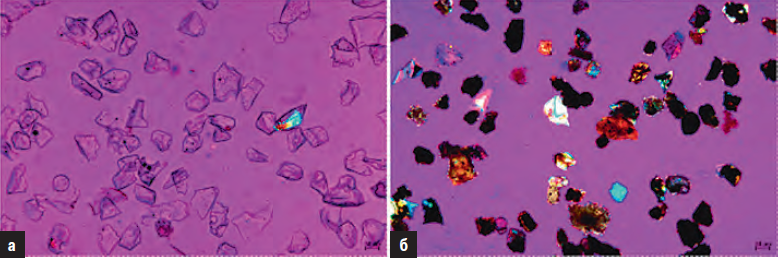
Fig. 1. Optical polarizing microscopy images of (a) GGBS, (b) GEOFS.
Table 1 has demonstrated the elemental composition of GEOFS in the form of corresponding oxides, derived from XRF analysis. From this composition, it has been found that the ratio of CaO and SiO2 content is near 2.4. So CaO and SiO2 may combine for some calcium silicate-based cementitious phases like dicalcium silicate, tricalcium silicate, etc. Different phases present in GEOFS have been investigated further by XRD analysis.
Table 1
XRF analysis report of GEOFS
| Components | Content in GEOFS, % |
| Loss on Ignition | 6.262 |
| Content: | |
| CaO | 31.530 |
| MgO | 18.330 |
| SiO2 | 13.130 |
| Al2O3 | 4.870 |
| Fe2O3 | 20.200 |
| MnO | 3.480 |
Fig. 2 demonstrates the XRD diffractograms of GGBS, Portland clinker and GEOFS samples. Appeared broad signal of the GGBS sample suggests the amorphous nature of the material. The sharp signals of both the diffractograms of clinker and EOF slag suggest the predominated crystalline nature of both samples. Moreover, there are certain signals appeared in both the diffractograms of EOF slag and clinker (marked with a red dotted arrow in Fig 2). Those common signals (30.1, 32.1, 29.4, 34.26°) are probably responsible for crystalline phases of dicalcium silicate and tricalcium silicate [6].
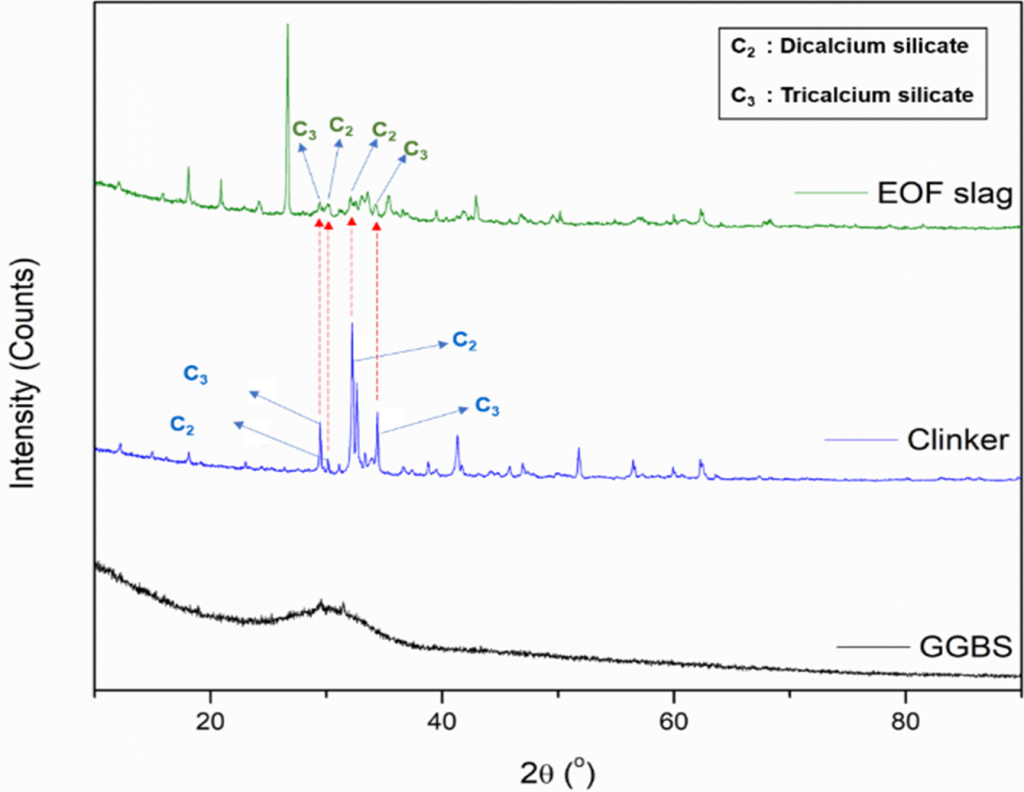
Fig. 2. X-ray diffractograms of GGBS, clinker, and GEOFS. C2 — 2CaO · SiO2, C3 — 3CaO · SiO2
Fig. 3 represents the individual diffractogram of EOF slag with phase identification and phase quantification data. The quantitative analysis was performed by Rietveld analysis using the ICSD database (ICSD:161510, PANICSD:98-016-1510). Among the identified phases dicalcium silicate and tricalcium silicate offer hydraulic binding properties, whereas zeolite provides significant pozzolanic reactivity in cement hydration reactions [6]. Hence the XRD analysis suggests that GEOFS has the potential to be a supplementary cementitious material.
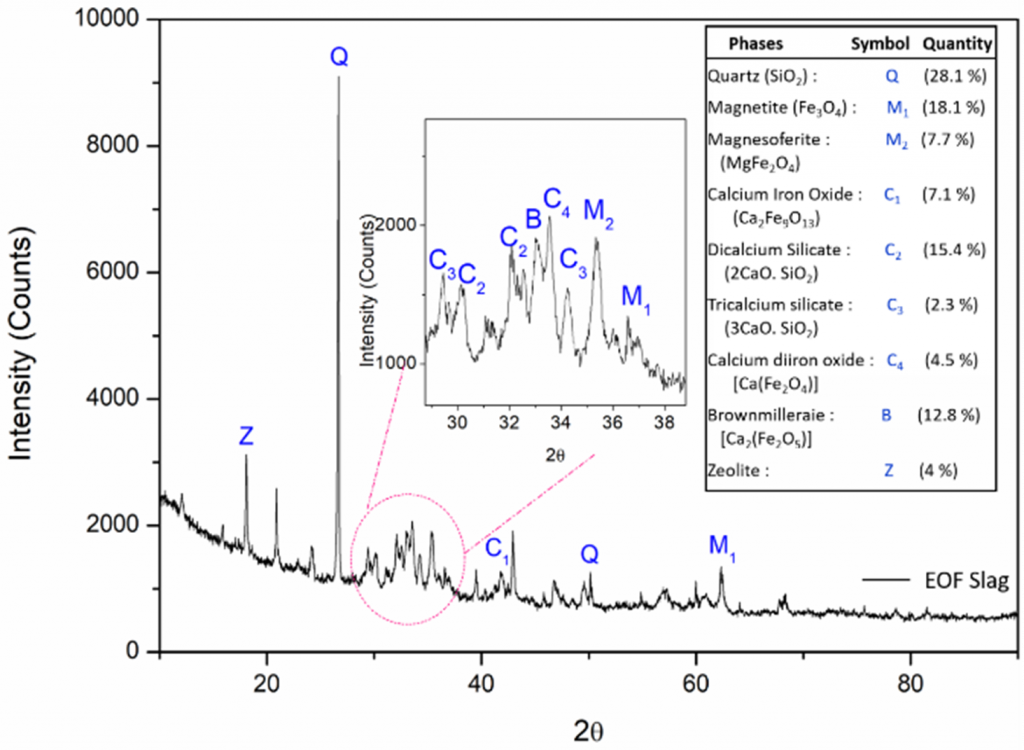
Fig. 3. X-ray diffractogram of GEOFS with phase identification and quantification data
Blended cements. Different compositions of blended cement were made (50 kg each) by blending OPC (50 %), GGBS (35—50 %) and GEOFS (0—15 %). The compositions of the produced blended cements with GEOFS content up to 10 % are shown in Table 2. Total slag content in these cements corresponds to cements of the Portland Slag Cement (PSC) class.
Table 2
Composition of blended cements, %
| Grade of blended cement | OPC | GGBFS | GEOFS |
| PSC 1 | 50 | 50 | 0 |
| PSC 2 | 50 | 47.5 | 2.5 |
| PSC 3 | 50 | 45 | 5 |
| PSC 4 | 50 | 42.5 | 7.5 |
| PSC 5 | 50 | 40 | 10 |
The developed blended cement (PSC 1 to PSC 5) was analyzed for different physical parameters according to Indian Standard (IS: 4031). Table 3 demonstrates the results. Normal Consistency (N.C.) of cements containing GGBS and GEOFS (less than 27 %) is slightly lower than for cement containing GGBS only, it indicates that the addition of GEOFS causes a slight reduction of water demand in developed blended cement.
Le-Chatelier and autoclave expansion studies have demonstrated very negligible extent of expansions for all the grades. The determined setting times (initial and final) of the developed cement have shown that the addition of GEOFS did not affect the normal setting of PSC 1 Cement.
Table 3
Physical parameters of blended cements
| Parameter | Cement | The permissible limit as per IS: 4031 | ||||
| PSC 1 | PSC 2 | PSC 3 | PSC 4 | PSC 5 | ||
| Normal consistency, % | 28.00 | 26.75 | 26.75 | 26.50 | 26.50 | — |
| Le Chatelier expansion, mm | 0.00 | 1.00 | 0.00 | 1.00 | 1.00 | 10 (Max.) |
| Autoclave expansion, % | 0.003 | 0.004 | 0.006 | 0.008 | 0.012 | 0.8 (Max) |
| Setting time, minutes: | ||||||
| initial | 140 | 145 | 135 | 125 | 125 | 30 (Min.) |
| final | 190 | 225 | 230 | 215 | 220 | 600 (Max.) |
| Compressive strength, MPa, depending on curing time: |
|
|||||
| 1 Day | 17.35 | 19.10 | 19.35 | 19.75 | 18.75 | — |
| 72 + 1 Hrs (3 Days) | 28.53 | 32.07 | 29.03 | 30.66 | 29.53 | — |
| 168 + 2 Hrs (7 Days) | 38.00 | 44.93 | 42.80 | 44.37 | 40.90 | — |
| 672 + 4 Hrs (28 Days) | 57.16 | 64.63 | 63.83 | 63.00 | 61.30 | — |
The measurement of heat flow and total heat of hydration were measured for 7 days. Fig 4 has demonstrated the Heat flow curve concerning the hydration reaction coordinate (Fig 4, a) and cumulative liberated heat (heat of hydration) concerning the reaction coordinate (Fig. 4, b). The heat flow curve (Fig. 4, a) has demonstrated the two heat flow maxima (Peak P1 and Peak P2, Fig 4, a) for all five samples almost in the same time intervals. This indicates the occurrence of maximum reaction rates of the cement hydration. Comparing the nature of the curve of all samples it was found that the PSC 1 has demonstrated the Peak P2 with lower height compared to the other four samples. This indicates that some additional exothermic heat flow happened in the other four samples (PSC 2 to PSC 5). Hence it is clear that the addition of GEOFS (PSC 2 — PSC 5) provides some additional reactivity.
Again from the cumulative heat vs time plot (Fig. 4, b), it was found that the cumulative heat of hydration of PSC 1 (for 7 days) is less than comparatively other four samples (PSC 2 — PSC 5). Hence the additional heat of hydration found in PSC 2 — PSC 5 can be considered as contributed by GEOFS reactivity. So the determination of heat of hydration experiment supports the existence of additional reactivity of GEOFS in blended cement hydration.
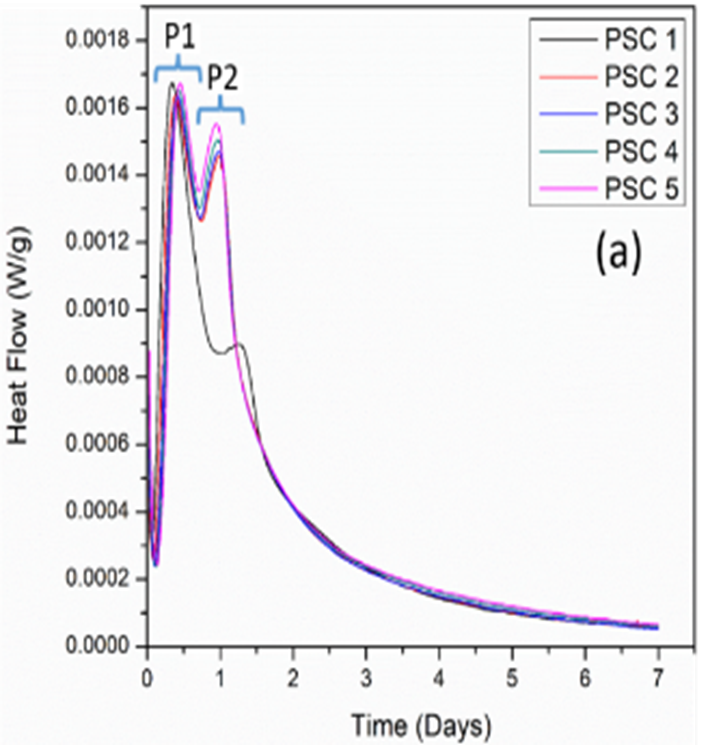
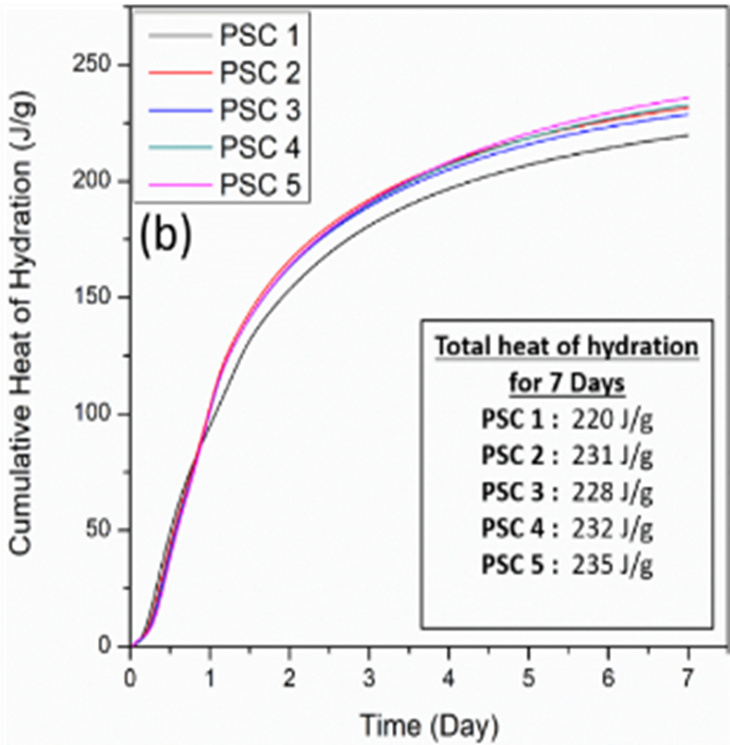
Fig. 4. Heat flow curve concerning cement hydration time (a) and cumulative heat liberated (b). Total heat of hydration for 7 days: PSC 1 — 220, PSC 2 — 231, PSC 3 — 228, PSC 4 — 232, PSC 5 — 235 J/g
Concrete trial. Lab-scale concrete trial has been performed with the developed blended cements (PSC 1 to PSC 5). The concrete mix design, kg/m3, was as follows: cement — 440, 20 mm aggregate — 641, 12.5 mm aggregate — 427, crushed stone sand — 725, water — 185.
The data on workability of concrete, fresh wet density, and CS after water curing has been demonstrated in Table 4. It was found that all the developed cement samples (without GEOFS and with GEOFS) showed comparable workability (till 1 h) with gradually decreasing slump height for concrete. This supports the compatibility of GEOFS for concrete applications which provides similar workability with control (PSC 1: cement without GEOFS). Moreover, an increasing fresh wet density of the concrete mix was found while moving from PSC 1 to PSC 5. This can be explained by considering the more replacement of low-density GGBS (Bulk Density: 1.003 g/cc) by high-density GEOFS (1.222 g/cc) in PSC 2 to PSC 5.
Table 4
Details of concrete trial for blended cements
| Parameter | PSC 1 | PSC 2 | PSC 3 | PSC 4 | PSC 5 |
| Fresh wet density, kg/m3 | 2403 | 2412 | 2418 | 2420 | 2423 |
| Workability (slump height), mm: |
|
||||
| initial | 125 | 135 | 130 | 135 | 130 |
| 30 min | 100 | 100 | 100 | 95 | 100 |
| 60 min | 65 | 65 | 70 | 70 | 65 |
| Compressive strength, MPa, for curing time: |
|
||||
| 72 + 1 hrs (3 days) | 17.50 | 17.86 | 16.90 | 18.05 | 17.15 |
| 168 + 2 hrs (7 days) | 23.24 | 25.47 | 23.73 | 24.43 | 23.77 |
| 672 + 4 hrs (28 days) | 35.47 | 37.60 | 36.00 | 37.27 | 35.87 |
Concrete cubes for all five cement samples demonstrated gradually increasing CS with a progressive time scale (3 days — 7 days — 28 days). This indicates that the normal cement hydration process with time in all concrete cubes, is in progress. Comparing the trend of CS of the concrete cubes of all five cement samples (PSC 1 to PSC 5), it was observed that 28 days’ CS of PSC 2, 3, and 4 is higher than PSC 1. PSC 5 showed a similar CS to PSC 1. This indicates that the addition of GEOFS shows a positive effect on strength gain for the dosage of 2.5 % to 7.5 %. This result exactly reflects the trend of CS that appeared for the mortar cubes (see Table 3). Hence GEOFS can be considered as a potential supplementary cementitious material as well as a performance enhancer for cement and cement based materials.
4. Сonclusions
It has shown that EOF slag contains some cementitious phases and a phase which shows good pozzolanic behavior for cement hydration. The developed blended cement with a 2.5 to 7.5 % addition of GEOFS has demonstrated significant improvement in compressive strength for both mortar and concrete applications, compared to the control sample (PSC 1, without GEOFS) while other properties were at the same levels. The heat of hydration determination by the isothermal calorimetry technique has proven the existence of additional reactivity of GEOFS in cement hydration.
Hence it is believed that EOF slag application to make cement is a potentially sustainable approach from the aspect of waste management as well as circular economy.
REFERENCES
1. Concrete needs to lose its colossal carbon footprint // Nature. 2021. Vol. 597. P. 593—594. doi: https://doi.org/10.1038/d41586-021-02612-5.
2. Aïtcin P.-C. Supplementary cementitious materials and blended cements // Sci. and Technol. of Concrete Admixtures. 2016. P. 53.
3. Indian Minerals Yearbook 2018. Pt.II. Metals and Alloys, 57th Addition, Slag-Iron and Steel. 2018. P. 16. Available at: https://ibm.gov.in/writereaddata/files/02182020101538Slag_Iron_Steel_2018.pdf (дата обращения 03.09.2025).
4. Sabapathy Y.K., Balasubramanian V.B., Shankari N.S., Kumar A.Y., et al. Experimental investigation of surface modified EOF steel slag as coarse aggregate in concrete // J. of King Saud University — Engin. Sci. 2017 Vol. 29. P. 388.
5. Malathy R., Arivoli M., Chung I.M., Prabakaran M. Effect of surface-treated energy optimized furnace steel slag as coarse aggregate in the performance of concrete under corrosive environment // Construction and Building Materials. 2021. Vol. 284. P. 122840.
6. Zheng X., Liu K., Gao S., Wang F., et al. Effect of pozzolanic reaction of zeolite on its internal curing performance in cement-based materials // J. of Building Engin. 2023. Vol. 63. P. 105503.
| Author: J. Kole |
| Section: Waste utilization |
| Keywords: EOF slag, circularity, sustainability, blended cement |